|
|
Colonial Era (First Fleet 1788 to Federation 1901)
This is just a small sample of what is on display at the museum.
Click on images to see larger view.
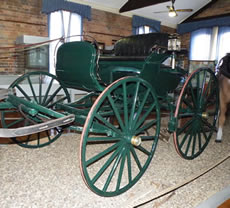
Canoe Front, Turtle Back Buggy
This circa 1880s buggy was originally owned by members of the Morton and Morton family, who commenced a legal practice in Maryborough in 1874. The business is
still in existence today and located further up Wharf Street from the Museum.
Thomas Morton commenced legal training at Maryborough in 1869 and at the time of his death in 1929, was the senior practicing solicitor in Queensland. His son
Hugh served in the company from 1902 until his untimely death in 1936 at the age of 54.
Probably after the death of Hugh the buggy was sold to Albert Beikoff who owned a property 18 miles from Maryborough on the Biggenden Road.
Mr Beikoff owned the buggy for about 40 years before selling it to collector Neville Lindley who has owned it since 1970, and kindly loaned it to the Museum.
During the era of buggies, up until the introduction of motor cars in the 1920s, this buggy was considered to be one of the best in Maryborough.
Buggy Connection to Major Duncan Chapman
Prior to WWI, Duncan Chapman was employed for a time at Morton and Morton as an articled clerk. Due to his previous part-time militia
service he was appointed as a Lieutenant in the 9th Bn AIF and was the first soldier ashore at Gallipoli on the morning of 25 April 1915.
|
|
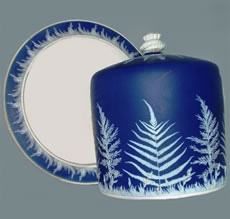
This blue and white covered cheese platter forms part of the Aldridge Collection held by the Museum.
One of the early pioneers in the Maryborough area, Edgar Thomas Aldridge led an exploration party into the area in 1848. He was instrumental in deciding on the
original site for the town of Maryborough which was initially known as Baddow.
Edgar became a respected businessman, owning the Bush Inn which today is the Royal Hotel in Kent Street. In 1883 he constructed the present 'Baddow House', an
elaborate Victorian building, where he lived until his death in 1888.
The items in the collection were donated to the Museum by the last surviving member of the Aldridge family.
|
The dress uniforms and a spiked helmet belonging to Lieutenant Colonel Colin Dunlop Wilson Rankin have been placed on permanent loan to the
Museum by the Maryborough Delta Company 9 RQR, formerly the Wide Bay Regiment.
Lt. Col. Rankin (1869-1940) was a soldier, politician (representing Burrum in the Legislative Assembly), a cane farmer and Director of Queensland Collieries Ltd. at
Howard. He joined the Queensland Defence Forces in 1886 and was a Major when the South African War broke out.
He volunteered for service in 1900, was appointed second-in-command of the First Australian regiment of Mounted Infantry, but was invalided and returned to
Queensland in 1901. In 1903 he was promoted lieut-colonel of the Wide Bay Infantry Regiment assuming command in 1906. He served briefly in World War One.
His daughter (Dame) Annabelle Rankin became the first woman to enter the Federal parliament from Queensland.
|
The Warry family was prominent among the pioneering families of Maryborough. Thomas Symes Warry, known as T.S. Warry, arrived in Maryborough
in 1880 and founded what was to become Warrys Pty. Ltd.
In 1881 his brother R.S. Warry was invited to join the firm and it prospered for almost 100 years. It was well known for the brand 'Auburn', which was to become a
household name throughout the Wide Bay-Burnett region.
Throughout their lives the Warry family contributed to the community by hard work, whether it be in times of emergency, or through their involvement with church or
supporting activities.
The remaining family now share some of those times, by placing on loan to the Museum items of memorabillia from as far back in time as the 1880's.
|
|
|
|
|
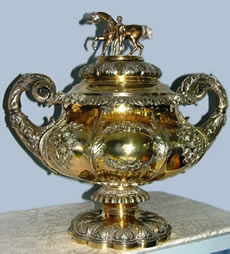
Gold plated sterling silver cup was London manufactured in 1827.
The horse and jockey lid have been added prior to its presentation as the Doomben Cup in 1950.

|
|
Short Sleeve Dress
circa 1880's.
Worn by Ada McDowell, wife of Queensland celebrated surveyor Archibald McDowell.
|
|
'Sydney Belle' This ship brought the last Kanakas to Maryborough from the South Sea Islands on the 20th October 1903.
The Kanakas were used in the district to cut sugar cane from 1867 to 1903.
.... no larger image available.
|
|
Items collected by Noela Tomlin from the Old Coach Road between Maryborough and Biggenden.
The Coach Road was used by bullock teams and wagons in the 1800's as the only access to Maryborough other than by ship.
Includes coinage of the times, buttons, buckles, pistol and musket balls.
|
A bit of history ....
Maryborough was settled in 1847 and is one of Queensland's oldest provincial cities. Located three hours from Brisbane, Maryborough was a major immigration port into
Australia and a visit to the City's historic port area Portside retains many reminders of this period. The port may be long dormant, but its history and gloriously
preserved buildings remain, along with a sense of time suspended.
Maryborough is one of Queensland’s oldest cities. In early colonial times it was the second most important port on the East Coast of Australia after Sydney and at one
stage was the rival for Brisbane as the site for the new state capital.
Maryborough has a rich history few cities could rival. But what really sets Maryborough apart is that much of that heritage remains. It is living history, captured in
beautiful old homes and buildings, outstanding museums, iconic historical characters and events, festivals and ghostly tours.
|
|